

Spotlight Build #9: On-Site Sim Builds at Sebring
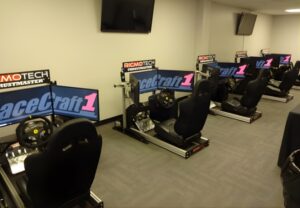
We took 5 race simulators to Sebring — and changed how drivers were evaluated
What if you could evaluate a racing driver before they ever turn a wheel?
That’s exactly what happened when RaceCraft1 transported five professional-grade racing simulators from Indianapolis to Sebring, Florida.
These weren’t entertainment units.
They were part of a real driver evaluation program.
Drivers rotated through on-track sessions, media interviews, physical assessments, and simulator-based performance testing — allowing teams to observe consistency, adaptability, and decision-making without burning tires, engines, or budgets.
For many involved, that weekend permanently changed how they viewed simulation.
This wasn’t theory.
It was proof.
Curious how portable simulators can support driver evaluation, training, or events?
 Book time with Kelly Jones to talk it through.
Some of the most effective driver development happens before anyone rolls onto the track.
Spotlight Build #10: University / Research Simulator
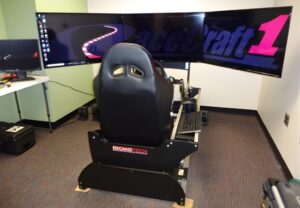
What simulators reveal about driver performance beyond lap times
What if driver performance could be evaluated under repeatable, controlled conditions instead of relying only on lap times?
That question is why a major university’s kinesiology department partnered with RaceCraft1 to design and operate a research-focused simulation system.
This simulator lives in a laboratory environment, not a game room. It was built to isolate performance variables, repeat scenarios, and measure how drivers respond to fatigue, pressure, and decision-making demands over time.
Drivers use the system to run consistent scenarios while researchers observe changes in reaction time, awareness, and cognitive load as conditions evolve. Because variables can be controlled and repeated, patterns emerge that are difficult to capture on track alone.
This matters because elite performance is rarely limited by raw speed. Breakdowns often occur in focus, decision-making, or fatigue management — areas that simulation can measure with precision and revisit deliberately.
Simulation isn’t a shortcut. It’s a tool for understanding where performance breaks down and why.
Curious how this kind of simulation can help identify and train performance limits?
Let’s talk it through.
Spotlight Build #11 — Custom Bespoke Sim
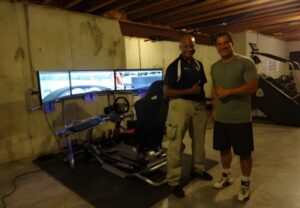
Experienced drivers know this feeling.
The lap time is fine.
The data looks fine.
But something doesn’t sit right.
That discomfort is usually the point.
Several years ago, a driver came to us with a problem no manufacturer could solve.
Different brands.
Different components.
Different mounting requirements.
Nothing on the market fit how he drove or how he wanted to work.
So we didn’t buy a solution.
We engineered one.
RaceCraft1 designed and fabricated a fully bespoke simulator. Custom structure. Custom interfaces. Built around one driver’s preferences, not a catalog. It wasn’t about novelty or aesthetics. It existed because compromise was quietly limiting consistency.
That simulator is still in regular use eight years later.
This matters because familiarity and trust are performance tools. When your environment stops asking you to adapt, your attention goes where it belongs — decision-making, rhythm, awareness. Fatigue drops. Mental load eases. Consistency becomes repeatable, not accidental.
Real performance tools aren’t disposable.
They age with the driver.
RaceCraft1 remains available for drivers who find themselves asking what’s missing rather than what’s available.
Spotlight Build #12 - Youth Driver Development
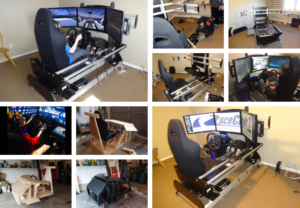
This wasn’t about gaming.
It was about development.
The driver was eight years old. A national champion already, but still at the beginning of a long trajectory.
The goal wasn’t performance in the moment—it was building correct habits that would hold up over time.
RaceCraft1 helped transition the driver from a simple, wood-frame simulator to a professional motion platform. The system was integrated into daily training, home-schooling, and long-term remote coaching.
The driver helped assemble parts of the simulator himself. It became part of how he learned—on and off the track—not a standalone tool.
That driver is now 18.
Still racing. Still progressing.
When skills are introduced correctly at a young age, they compound quietly over time.
If you’re exploring simulation for youth development or long-term growth, feel free to reply.
That’s often where these conversations begins.
Early structure doesn’t create pressure. It creates options later.
Have questions? You’re welcome to book time with me here.
Spotlight Build #13 - Twin Sims
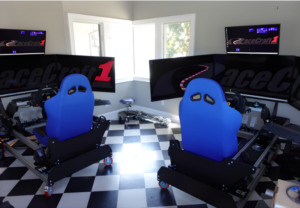
A racing simulator is a driver’s personal training domain.
Seating position.
Pedal geometry.
Steering response.
Visual alignment.
When more than one driver shares a single system, compromise follows.
This twin build removed compromise.
RaceCraft1 installed two complete simulators in a private residence for two serious drivers training under the same roof.
Each system was tuned to its driver.
Different preferences.
Same standard.
They can run sessions simultaneously.
Compare laps immediately.
Refine technique side by side - without resetting anything between sessions.
The result wasn’t just convenience.
Training frequency increased.
Session intensity increased.
Accountability became built-in.
Two systems eliminated waiting.
Eliminated adjustment.
Eliminated excuse.
That’s what twin builds solve.
Environment dictates performance.
If more than one driver in your home is serious about performance - and you’re feeling the limitations of sharing - we’re always open to a good conversation.
When two drivers train without compromise, standards rise — and so do results.